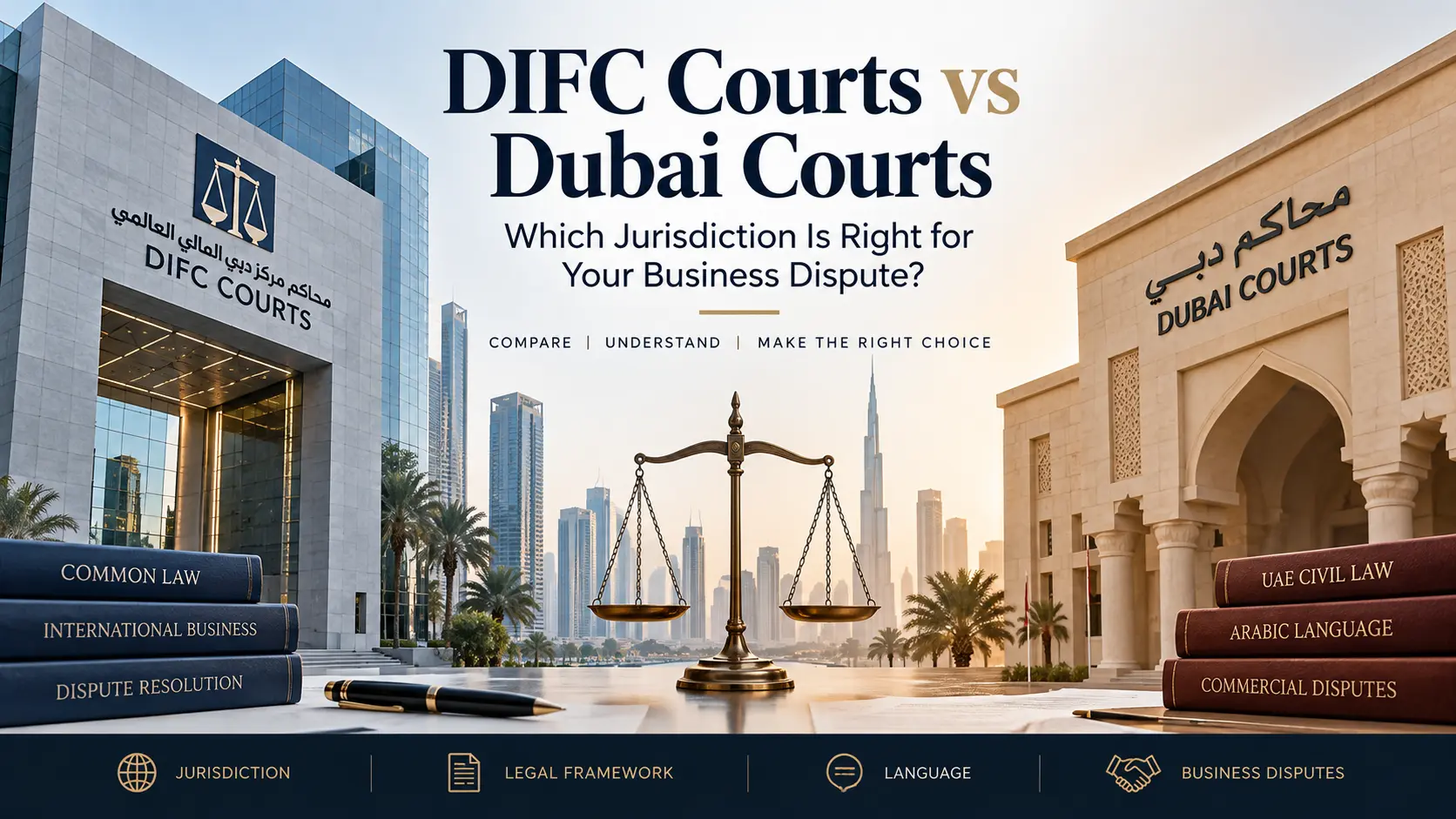
If the commercial partnership fails and a dispute occurs, the decision on where to deal with it becomes important. In Dubai, businesses have two different courts of jurisdiction to consider: the DIFC Courts and the Dubai Courts. Understanding the DIFC Courts vs Dubai Courts can help businesses determine which court may have jurisdiction over their commercial dispute.
Which court has jurisdiction, however, is governed by who the parties are, how the contract was structured, and the location of the transaction. This detailed insight provides a comprehensive overview of DIFC courts vs Dubai courts, explaining which each has jurisdiction, and sets out the practical factors affecting a business’s decision, or contractual agreement, as to which court will hear their dispute.
DIFC Courts vs Dubai Courts: What Is the Difference?
Dubai Courts
Dubai Law No. 3 of 1992 set up the Dubai Court, also known as the emirate’s Onshore or Mainland Court. It is an Arabic-language court system that draws on the UAE federal civil and commercial legislation alongside Dubai-specific law.
Choosing the right court for your business dispute comprehensively hinges on the parties engaged, how the parties drafted the contract, the type of dispute, and what a business needs out of the process, covering language and procedures to methods of enforcement.
DIFC Courts
Dubai Law No. 12 of 2004 originally established the DIFC Court. It is an independent, English-language common law court, and the DIFC Courts Law (Dubai Law No. 2 of 2025) now governs it.
This judicial system operates within the DIFC, but in some circumstances its jurisdiction expanded far beyond the free zone boundaries.
When Do DIFC Courts Have Jurisdiction?
Under Article 14 of the DIFC Courts Law, it shall have jurisdiction to hear a civil or commercial claim in a matter if parties follow one of the following jurisdictional gateways.
DIFC connection – A DIFC body or a DIFC-registered entity makes or faces the claim, which derives from a contract the parties made or will perform in the DIFC, relates to an occurrence or transaction taking place in the DIFC, or relates to employment the DIFC governs.
The applicable legal requirements govern this ‘opt-in’ pathway, and courts count it as a sufficiently clear and express agreement, and, interestingly, DIFC case law has indicated that even the words “the courts of Dubai” may do this in certain cases.
A Specific Statutory Basis – special legislation covers a number of matters that would not otherwise be subject to the DIFC Courts’ jurisdiction, such as some arbitration applications and insolvency proceedings, and, therefore, they come within the scope of the DIFC Courts’ jurisdiction.
It is a legal issue whether a given point of dispute really is in one of these gateways; it depends on the facts and how exactly parties use the words, and so courts have to decide it based on the facts of each case rather than assume it.
When Would a Business Use Dubai Courts?
Most commercial dispute matters in Dubai involving mainland enterprises or UAE individuals take place entirely onshore and go to the Dubai Courts. In particular where none of the DIFC gateways described above are engaged.
So, if the contract simply states the Dubai Courts matter, or the case involves enforcement of the contract on the mainland. Additionally, the contract imposes no direct or exclusive link to the DIFC; the Dubai Courts will settle most matters.
For enterprises without a connection to the DIFC at all, the vast majority of mainland trading companies, LLCs, and service providers will generally have their commercial disputes decided by the Dubai Courts under UAE civil commercial law in Arabic and under the UAE civil procedure.
Can a Mainland Company Use the DIFC Courts?
Sometimes, but not as a matter of right. Sometimes, but not as a matter of right. A mainland company is not entitled to bring all commercial disputes before the DIFC Courts merely because it prefers an English-language, common-law forum over the Dubai courts. And this is where professional contract drafting services become essential, ensuring jurisdiction is addressed before a dispute arises.
As of general rule, access will still be subject to one of the gateways to jurisdiction outlined, which is:
- Contracting with a DIFC entity or with a counterparty registered in the DIFC
- Or having entered into or performed a contract wholly or partly within the DIFC,
- Or, agreeing, in a valid written clause, to opt into DIFC Courts jurisdiction.
In the absence of one of these gateways, parties should generally refer disputes involving a mainland company either to Dubai Courts or arbitration in case they are arbitrable.
Accordingly, mainland companies address this at the contract drafting stage, rather than assuming it will be available after a dispute has already arisen.
Can Businesses Choose DIFC Courts in a Commercial Contract?
In most cases, the answer is yes. By including a jurisdiction clause in their contract, businesses can choose the DIFC Courts as the forum for resolving certain commercial disputes. The parties can make this decision when entering into a commercial relationship, establishing in advance which court will have jurisdiction over disputes arising from their agreement.
This makes DIFC court jurisdiction an important consideration when drafting a commercial contract. A clear jurisdiction clause sets out the parties’ intended forum for resolving disputes and can provide greater certainty if a disagreement arises. Clearly stating this intention at the contractual stage can also help reduce uncertainty and potential disputes over which court should hear the matter.
The choice becomes particularly relevant when considering Dubai Courts vs DIFC Courts. Businesses should carefully state in their contracts whether they intend the Dubai Courts or the DIFC Courts to resolve disputes.
DIFC Courts vs Dubai Courts: Key Differences for Businesses
Here’s a comprehensive difference between DIFC Court and Dubai Courts, as mentioned below:
| Factor | DIFC Courts | Dubai Courts (Onshore) |
| Jurisdiction | A common law court located in the DIFC free zone. It deals with cases arising in the DIFC and is optionally available to parties outside the DIFC if they include an agreement to that effect in their contract. | The primary judicial system in Dubai. This is the court which resolves most civil and commercial disputes in Dubai, unless the parties have previously agreed to another court. |
| Legal Framework | Proceedings are conducted according to the DIFC court rules (the Rules of the DIFC Courts), which are in terms and closely based on the English Civil Procedure Rules. | It follows the UAE civil law system (a system of codified law based on the Civil Transactions Law and Commercial Transactions Law of the UAE). |
| Language & Procedure | Cases are conducted in English. The process is similar to Western courts, broadly modelled on but distinct from the English Civil Procedure Rules. | In each case the proceedings are in Arabic, and requiring foreign documents often means providing a certified translation. The proceedings are primarily written rather than oral. |
| Contractual Jurisdiction Clauses | An agreement can decide that a DIFC court will hear a dispute, even if the actual business does not have any connection with the DIFC. This clause has to be written in an explicit way to prevent issues later on. | If a contract does not explicitly select another court, in most cases Dubai courts will be accepted as the primary jurisdiction. Sometimes it is difficult to enforce contractual provisions for foreign courts. |
| Practical Dispute Considerations | chosen for international business transactions, financing, and contracts with foreign parties. As it is in English and uses commonly understood legal principles. | Often suitable for local disputes, real estate, and labour matters. Translation requirements may slow the process for foreign parties. |
What If the Contract Does Not Clearly Specify Jurisdiction?
If the contract does not specify jurisdiction or uses loose wording such as an unqualified reference to “Dubai courts”, there is real potential for a dispute over which forum should hear the case before parties even address the underlying commercial dispute.
One party may argue for the DIFC Courts, the other for the Dubai Courts, and DIFC case law has demonstrated that broad references to the courts of Dubai can include the DIFC Courts, depending on the circumstances and how courts interpret them.
This can lead to uncertainty, delay, cost and second-guessing as to which court should be the primary forum to hear the dispute. A major risk reduction measure is to understand the distinction between Dubai Courts and DIFC Courts when drafting and ensure the jurisdiction clause reflects it.
Which Court Is Right for Your Business Dispute?
One size does not fit everyone. Similarly, there is no one answer that applies to every business. The following questions may be a useful initial checklist when determining which forum is likely to apply or which forum parties should adopt when formulating new contractual documentation:
- Who are the parties, and where are they incorporated/located?
- What exactly is the existing jurisdiction clause in the contract?
- Does it mention or refer to the DIFC Courts or Dubai Courts, or is it vague?
- Is the transaction or any part of it connected to the DIFC?
- Where did the contract take place?
- Where is the dispute related to – real estate, employment, general commercial, insolvency or arbitration?
- Where is the subject matter of a possible dispute?
With the continual evolution of jurisdictional gateways, opt-in conditions and relevant case law, it is preferable to work through these questions with specific legal advice rather than treat them as a self-help guide to an ongoing dispute.
Which Dubai Law Firms Specialise in Commercial Contract Disputes: Klay Legal
With vast opportunities available across the UAE legal landscape, navigating the right forum and drafting a jurisdiction clause becomes considerably important. At Klay Legal, our Corporate & Commercial Law Service UAE teams regularly advise businesses across Dubai and the UAE on dispute resolution strategy and contracts.
If you are seeking a new commercial contract, reviewing an existing jurisdiction clause, or already embroiled in a business dispute and require a UAE business dispute lawyer to advise on forum and strategy, contact Klay Legal to review your legal options.
Conclusion
Determining the forum of dispute resolution between DIFC Courts or Dubai Courts is an important consideration. Disputes inevitably arise in commercial relationships, and choosing the appropriate dispute resolution forum is an important factor that the drafting of commercial arrangements and contracts will reflect.
The choice between the forums will vary depending on the circumstances of the dispute, the parties, the legal system, the language and the procedures of the contract and any clauses in the underlying contract. It is better to clarify jurisdiction issues in the initial contract-drafting stage than to leave it until a dispute occurs.
Whether your dispute involves local commercial matters across Dubai or international transactions, seeking advice from experienced corporate & commercial lawyers in Dubai familiar with DIFC matters can ensure you select the appropriate forum and create clauses that safeguard your interests from the start.