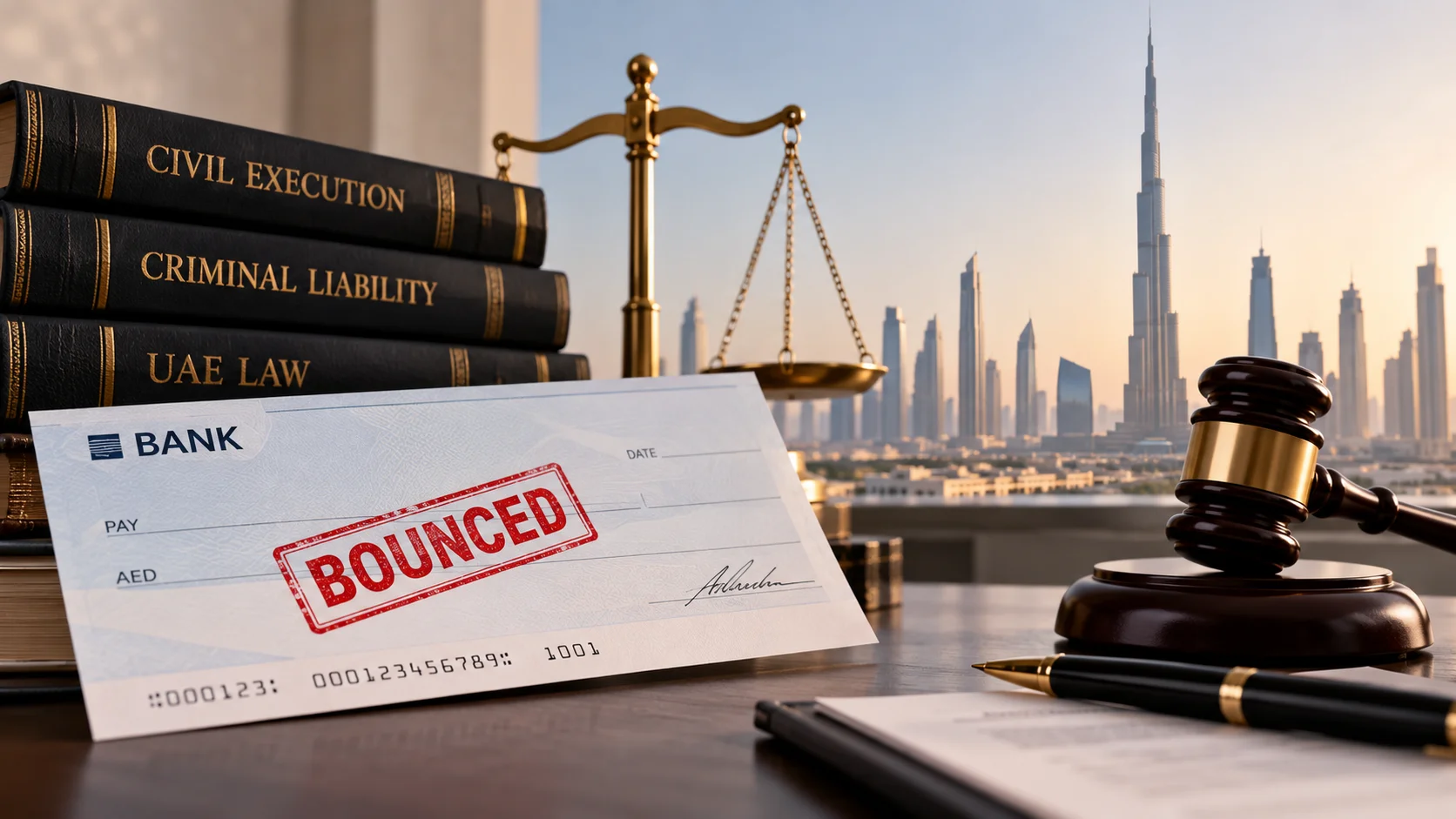
A bounced cheque in UAE can raise several questions. You may have issued a cheque that the bank returned or deposited a cheque that was returned unpaid. Why was the cheque returned? How can the outstanding money be recovered, and what legal actions are available?
The circumstances can determine whether civil execution, criminal liability, or other legal remedies may apply.
Not every bounced cheque amounts to a criminal offence. UAE law provides mechanisms for cheque recovery. Klay Legal explains what happens after a bounced cheque in the UAE, how cheque holders can pursue recovery, when criminal liability may arise, and what cheque issuers or drawers should know.
What Happens When a Cheque Bounces in the UAE?
The common reason why a cheque bounced is due to lack of funds or insufficient funds in the account. As a result, the holder can end up directly in the execution court. A full civil lawsuit is not needed first. This is not usually a criminal case.
Here is the general position:
The Reason for Return is Crucial – It plays a significant role, as the bank’s written reason decides which route will apply.
Civil Execution of Bounced Cheques – It is the most effective way to recover deficits. The bounced cheque can serve as an enforceable document.
Criminal liability plays a key role – The only area we may still find criminal liability, which includes stopping payment without a valid reason, closing an account, or forging a cheque.
Next step – Get the bank’s dated return statement and keep the original cheque safe.
What Changed in UAE Cheque Law?
In the past, a bounced cheque was commonly treated as a criminal matter, even when the issuer simply ran short of money. That has changed.
Federal Decree-Law No. 14 of 2020
It amended the old Commercial Transactions Law. Its cheque provisions took effect on 2 January 2022. It removed criminal liability for cheques returned only for insufficient funds and made such cheques enforceable through execution.
Federal Decree-Law No. 50 of 2022
The current Commercial Transactions Law, issued on 3 October 2022 and effective from 2 January 2023, replaced the 1993 law while retaining and updating the legal framework governing cheques.
Businesses should also understand how these rules interact with their wider contractual obligations and commercial disputes. Learn more about corporate and commercial law in the UAE.
In the current law, the main cheque provisions include:
Article 667
A cheque marked by the bank as returned for no or insufficient balance is an executive instrument.
Articles 674 to 676
The offences that remain cover certain knowing delivery of cheques without funds, acts that prevent payment, and forgery.
Article 649 and Article 670
Presentation period and time limits for claims. The law now separates debt enforcement (civil) from bad-faith conduct (criminal).
Why Did the Cheque Bounce?
There are various reasons why a cheque in the UAE is bounced, such as insufficient fund, closed account, stop payment order and mismatch of signatures.
You should verify the bank’s explanation because it may affect your options for recovering the money and may even result in a criminal case against you.
A list of reasons may include:
- Insufficient or partial funds.
The account has less money than the cheque amount. This is the most common reason and is generally handled through civil execution.
- Closed or frozen account.
The route depends on the facts. If the account was closed or emptied on purpose to avoid payment, criminal exposure may arise. If it was frozen for another reason, the analysis is different.
- Stop-payment instruction.
The law allows objections to payment only in limited situations. A stop-payment instruction without a valid reason can lead to criminal liability. A commercial dispute alone does not automatically justify it.
- Defective signature or forgery.
A signature that does not match the bank’s records is a different issue from forgery. A mismatch may be a simple error. Forgery is serious and needs the original cheque and often expert review. Never accuse someone of forgery based only on a return code.
- Security or guarantee cheques.
Many cheques are given as security for a loan, lease or contract, not as payment. Courts look at the facts and the underlying transaction. There is no safe, one-size-fits-all rule, so these cases need legal review.
How to Recover Money From a Bounced Cheque
If you are the cheque holder, here is a step-by-step explanation of what is necessary to recover the money from a bounced cheque.
Step 1: Confirm the return reason.
Get the bank’s dated statement showing the presentation date and the reason for return.
Step 2: Collect your documents.
The documents are listed as follows:
- The original cheque.
- The bank’s dated return statement or memo.
- Proof of deposit or presentation.
- The contract, invoice, loan or settlement behind the cheque.
- Records of any partial payment.
- Details of the issuer (and the company, if it is a company cheque).
- Written demands and replies.
- A calculation of the unpaid balance.
Step 3: Check the dates.
A cheque payable in the UAE should be presented within six months from the issue date written on it. Claims also have time limits under the law. These periods are not the same as ordinary contract claim periods, so do not wait.
Step 4: File an execution application.
The application goes to the execution court with the original cheque and bank notation. The court checks the parties, the amount, the bank notation and the procedural requirements. The Civil Procedure Law governs the application and any challenge to it.
Step 5: What happens after filing.
If the court approves the application, the issuer is served and has a period in which it can pay or oppose the order. If there is no payment, the court might exercise its powers of lawful enforcement.
This will be based on the facts, the evidence, and the decision of a judge. There is no certainty of an outcome or the time it may take.
What if direct execution does not apply?
Some cheques do not qualify. For example, the bank’s notation may not match the qualifying reasons, or the instrument may have a defect. In that case, the holder may need to file a regular civil claim on the underlying debt. If there is evidence of bad-faith conduct, a criminal complaint may also be possible. A lawyer can advise which route fits.
What Happens with Partial Payment?
If there are not sufficient funds in the account to cover the full cheque, then law requires the bank to pay the remaining amount when the holder asks, unless the holder refuses to accept any partial payment.
The bank notes the payment on the original cheque, issues a certificate and hands the cheque back to the holder. The holder then pursues the remaining balance. Every demand or execution request should be reduced by whatever has already been paid. The bank’s certificate acts as the evidence.
When Can a Bounced Cheque Still Lead to Criminal Liability?
When a cheque bounces on the grounds of insufficient funds alone, it isn’t considered a criminal offence nowadays. However, there may be criminal liability in respect of particular acts. The main provisions are governed under Articles 674 to 676 of Federal Decree-Law No. 50 of 2022.
Examples of conduct that may still be criminal include:
- Giving a stop-payment instruction without a valid reason.
- Closing the account or withdrawing the balance to stop the cheque being paid.
- Intentionally signing in a way that makes the cheque unpayable.
- Knowingly handing over a cheque when there are no funds available, in the situations the law describes.
- Forging or fabricating a cheque, or knowingly using a forged one.
A bank return alone will not demonstrate these offences. The prosecution has to prove the conduct and intent specified by the offence. Any penalties are determined by law and depend on the offence. Always verify the text or seek advice from a lawyer before relying on any figure.
If a Cheque You Issued Has Bounced
When your cheque to someone has bounced, it will be useful to know your legal recourse and what steps you could take. This is discussed below:
Settlement
Many cases settle. A good settlement will specify the sum, instalments, due dates, way of payment, any security, and what happens on default, and get receipts for every payment. Don’t overdraft or cancel the cheque until the agreement says so.
Execution
Read the execution notice carefully. Check the cheque, the amount, the claimant and the requested measures. Respond within the time allowed.
Possible Objections.
Depending on the facts, an issuer may raise payment, set-off, a defect in the cheque, lack of authority, or another legal ground. An objection needs a real basis and supporting documents.
Security Cheques.
If you gave the cheque as security and not as payment, tell your lawyer early and keep the contract and messages that show this. Do not assume this is a complete defence.
Company Cheques.
who signed, who owns the account and whether the signatory had authority. Being a manager or shareholder does not by itself make a person personally liable. There must be a separate legal or contractual basis, or personal conduct that creates liability.
Check Your Case Status.
Use the official channels, such as the Dubai Courts website or app for execution cases, or the relevant police or prosecution channel for criminal matters. Filing requirements can change, so confirm them on the official site.
Bank and Credit Effects
Returned cheques can affect your banking relationship and credit record. If you are convicted of a relevant offence, there can be restrictions on cheque facilities. Ask your bank about its current rules.
What About Rental Cheques?
Cheques given for rent usually follow a separate route through the Rental Disputes Centre (RDC) in Dubai. Because the process has its own steps, it is handled differently from a standard cheque execution case. If your bounced cheque relates to rent, speak to a lawyer about the RDC route before you file anything.
What Should You Do Immediately After a Cheque Bounces?
Follow these steps, as a cheque holder or cheque issuer:
If you are the cheque holder:
- Get the bank’s written return statement with the date and reason.
- Keep the original cheque safe. Do not write on it.
- Record the issue date and presentation date.
- Save the contract, invoices and messages behind the cheque.
- Write a clear demand to the issuer and keep a copy.
- Calculate the balance, including any partial payment.
- Get advice before the time limits run out.
If you are the cheque issuer:
- Find out the exact reason the bank gave.
- Do not stop payment or move money without a valid legal reason.
- Collect the contract, invoices, payment proof and messages.
- Contact the holder early to discuss payment or settlement.
- Never ignore a notice from the court. Note every deadline.
- Put any agreement in writing and keep receipts.
- Ask a lawyer to review the file if the amount is large or the facts are disputed.
When Should You Speak to a Lawyer?
Many simple cases can move forward with the right documents. But legal help adds real value when:
- The cheque was given as security or guarantee, and the purpose is disputed. Courts look at the facts behind the cheque, so you need the contract and messages that show its true purpose.
- You received an execution notice and want to object. Deadlines are short, and an objection needs a real legal ground and supporting documents.
- The amount is high. A mistake costs more, whether you are recovering the money or facing enforcement.
- There may be criminal conduct involved, such as a stop-payment, account closure or forgery claim. Get advice before answering questions from the police or prosecution.
- A company signatory may face exposure. Personal liability depends on who signed, who owned the account and what authority they had.
- There is a cross-border element. The place of filing, service and enforcement may all be affected.
- Multiple cheques are involved. Each cheque may have a different return reason, date and route.
At Klay Legal, we review the return reason, the documents and the deadlines first. Then we explain the realistic options for holders and issuers, so you can decide the next step with a clear picture.
Frequently Asked Questions (FAQs)
Q1. Is cheque bounce a criminal offence in the UAE?
Not automatically. A cheque returned only for insufficient funds is generally handled through civil execution. Criminal liability remains for specific conduct such as unjustified stop-payment, account closure to avoid payment, and forgery.
Q2. How can I file a cheque bounce case in Dubai?
Keep the original cheque and bank return memo, then consider a legal notice. For insufficient-funds cheques, file an execution application through Dubai Courts, since the cheque is treated as an executive deed. For suspected bad faith, a criminal complaint may be possible. Verify current requirements first.
Q3. How can I clear a cheque bounce case in Dubai?
Pay or settle with the payee and obtain a written settlement or receipt. The payee must confirm it in the execution file or criminal case. Closure is not automatic; any court measures are lifted only after the court processes the settlement.
Q4. Can a bounced cheque lead to a travel ban?
Not automatically. Before the reforms, criminal complaints over insufficient-funds cheques could lead to travel bans. Today, restrictions depend on the case type and on measures requested or ordered in execution or criminal proceedings. Check your case status and current rules with Dubai Courts or a lawyer.